
Understanding Foundation Settlement in Niagara: Causes, Signs, and Solutions
/The foundation is the most critical component of any structure, literally supporting the entire weight of your investment. For homeowners, property managers, and investors in the Niagara region, understanding the challenges posed by foundation settlement is not just prudent, it's essential for long-term property maintenance and safety. This guide delves into what causes a settling foundation in this unique geographical area, the tell-tale signs to watch for, and the professional foundation repair solutions necessary to mitigate severe structural damage.
What is Foundation Settlement?
Foundation settlement refers to the downward movement of a structure's foundation relative to the original position upon which it was built. This natural process occurs when the soil supporting the structure compacts, shifts, or changes volume. The key distinction in diagnosing the severity of the issue lies in whether the settlement is uniform or differential.
Uniform settlement happens when the entire foundation sinks relatively evenly. While this can still cause some issues, the home often settles as a single unit, and the visible signs of structural damage are minimal.
Differential settlement, however, is the primary source of problems. This occurs when one section of the foundation sinks much more than an adjacent section, often due to variations in the underlying soil composition, moisture content, or loading. This uneven movement introduces significant stress and shear forces into the rigid structure above, leading directly to the classic, visible signs of a severely settling foundation and necessitating immediate foundation repair. The goal of any successful repair is to halt this differential movement and, where possible, restore the structure back to its original grade.
Causes of Foundation Settlement in Niagara
The Niagara Peninsula, shaped by glacial activity and bordering two Great Lakes, possesses a dynamic and often challenging geological profile. The causes of a settling foundation here are often rooted in these specific local conditions.
Soil Conditions
The foundation of a home is only as stable as the soil beneath it. In Niagara, several soil types present distinct risks:
Expansive Clay Soils: Certain areas of Niagara contain pockets of highly expansive clay. This type of soil possesses a high plasticity index, meaning it absorbs vast amounts of water, swelling significantly when wet (the "heave" effect) and shrinking dramatically when moisture is removed (the "shrink" effect). This constant, cyclical movement puts immense pressure on foundation walls and footings. Over time, this stress leads to fatigue and the eventual failure of the foundation, causing significant foundation settlement. Managing soil moisture is critical in homes built in these conditions.
Poorly Compacted Fill: Often, during new construction, the area around the foundation (the backfill) is excavated and then replaced. If this soil is not properly compacted in lifts—layers—before the structure is built, the weight of the house will naturally compact it over the following years. While this often manifests as uniform settlement initially, any unevenness in compaction can trigger differential foundation settlement, particularly under the corners or heavier load-bearing walls. This is a prevalent issue in rapidly developing subdivisions.
Organic Material and Voids: In older areas, foundations may rest partly on decomposing organic matter (e.g., old tree roots, buried debris) which break down over decades, creating voids and eliminating structural support. Similarly, subsurface erosion from prolonged water flow can wash away fine sand and silt particles, leaving unsupported sections of the footing, accelerating the downward movement of the settling foundation.
Drainage Issues
Water management is the single most critical factor in controlling foundation settlement. The stability of the soil directly correlates with its moisture content.
Surface Grading and Runoff: The fundamental rule of home maintenance is ensuring that the ground surface slopes away from the foundation by a minimum of 6 inches over the first 10 feet. If the grading is reversed or too flat, rainwater and snowmelt will pool directly against the foundation walls, saturating the supporting soil. Saturated soil loses its load-bearing capacity (shear strength), becoming soft and compressible, thereby allowing the structure to sink.
Defective or Missing Eaves-troughs and Downspouts: A standard roof can shed thousands of gallons of water during a heavy storm. If the gutter system is clogged, leaking, or if the downspouts terminate directly beside the foundation, this deluge of water is concentrated into a small area. This localized saturation can quickly soften the soil and initiate severe, localized foundation settlement at the discharge point, often leading to corner movement and stair-step cracking.
Subsurface Plumbing Leaks: Less visible but potentially more destructive are slow, consistent leaks from underground utility lines (water, sewer, storm drains). A persistent leak can silently wash away soil and create large subsurface voids beneath the footings. This localized washout is an extremely common cause of rapid, severe structural damage and requires urgent attention to both the plumbing and the subsequent foundation repair.
Construction Problems
Though less common than soil and water issues, problems that originate during the home's original construction can lead to significant foundation settlement years later.
Inadequate Footing Depth or Size: Building codes dictate that footings must be placed below the frost line (typically 4 feet in Niagara) to prevent movement from freezing and thawing cycles. If the footings were placed too shallowly or were undersized for the weight of the house, the foundation will inevitably experience instability, heave, or settlement.
Excavation and Adjacent Work: When adjacent lots undergo deep excavation or if heavy machinery is used nearby, the vibrations and changes in soil pressure can disturb the supporting soil beneath an existing foundation. This can cause the soil to liquefy momentarily or shift, resulting in a sudden, sharp instance of foundation settlement on the older structure.
Signs of Foundation Settlement
Early detection of a settling foundation is paramount. Homeowners should regularly inspect their property for the following critical indicators, as they signal the need for professional evaluation and potential foundation repair.
Cracks in Walls and Foundation
Cracks are the physical manifestation of the home’s stress points attempting to cope with uneven forces.
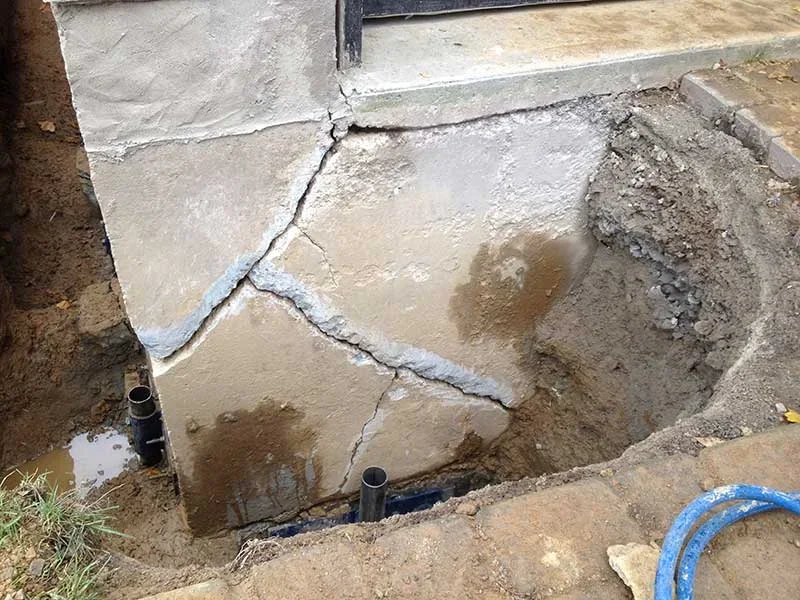
Foundation Wall Cracks: The most worrying cracks are those in the main concrete or block foundation. Diagonal cracks, running at a 30-45 degree angle, or stair-step cracks in concrete block or brick veneer, are hallmarks of differential foundation settlement. They usually start at a corner or below a window and widen as they move upward. Cracks wider than ¼ inch or those that show one side of the foundation wall pushing in or out are red flags indicating severe movement.
Interior and Exterior Finishes: On the interior, look for hairline cracks radiating from the corners of window and door frames, or cracks in the drywall or plaster where the ceiling meets the walls. On brick veneer exteriors, the stair-step cracks in the mortar joints are a definitive sign that the corner of the home is dropping relative to the rest of the structure.
Uneven Floors
When a section of the foundation drops, the floor structure above it is pulled down as well.
Sloping: Floors that have a noticeable pitch or slope towards the center of the house or a specific wall indicate that the foundation or the interior supports (like posts and beams) have settled.
Bouncing or Sponginess: While potentially related to structural wood issues, a sudden, new "bounciness" in a floor, accompanied by other signs, suggests that a support beam has lost contact with its footing due to foundation settlement.
Sticking Doors and Windows
Door and window frames rely on a perfectly square opening to operate smoothly. When the foundation moves, the house shifts, pulling the structure out of square.
Binding: Doors that stick, scrape the floor, or don't latch properly indicate the top corner of the frame has shifted down relative to the latch side.
Gaps: Conversely, if the gap around the door or window frame is significantly wider at the top than at the bottom, it confirms the frame is distorted due to movement in the load-bearing wall, a direct consequence of a settling foundation.
Is Foundation Settlement a Serious Problem?
Foundation settlement is not a cosmetic issue; it is a serious structural defect that can compromise the safety, value, and stability of a home. Ignoring a settling foundation will only ensure the problem becomes exponentially worse and more expensive to resolve.
The consequences of inaction include:
Catastrophic Structural Damage: Ongoing movement can eventually lead to the failure of load-bearing walls, compromise the roof structure, and make sections of the home uninhabitable.
Plumbing and Utility Disruption: Shifting foundations can shear or crack underground utility lines, leading to sewage backups, water leaks (which accelerate the settlement), and electrical conduit damage.
Decreased Resale Value: A foundation issue flagged on a home inspection report is a major impediment to a sale and almost always requires significant price concessions or mandatory foundation repair before a mortgage lender will approve financing.
Pest and Water Intrusion: Cracks caused by the settling foundation become direct conduits for moisture, leading to basement flooding, mold growth, and access points for rodents and insects.
Solutions for Foundation Settlement
When a professional structural engineer confirms differential foundation settlement, the solution is typically underpinning, a process that stabilizes the home by bypassing the unstable soil and transferring the structure's weight to a deeper, more reliable stratum.
Piering (Underpinning)
Piering is the definitive, long-term solution for severe structural damage caused by a settling foundation. It involves installing deep foundations beneath the existing footing.
Helical Piers: These steel piers resemble large screws. They are mechanically screwed into the ground deep below the unstable soil until they reach a predetermined torque or stable layer (e.g., bedrock or very dense till). A bracket is then secured to the existing footing, and the weight of the structure is transferred to the pier, stabilizing the home. Helical piers are ideal for lighter loads and locations where rock is very deep.
Push Piers: These steel pipe segments are hydraulically driven, or "pushed," deep into the ground using the weight of the house as a reaction force. They are driven to refusal, meaning they stop when they hit unyielding support. A heavy-duty steel bracket then connects the pier to the footing. Push piers are excellent for heavy structures and deep foundational support.
Both pier systems allow the foundation to be lifted back toward its original position and permanently supported, halting all further vertical foundation settlement.
Mudjacking / Polyurethane Injection (Slab-Lifting)
While not a solution for stabilizing a main, load-bearing settling foundation wall, these techniques are highly effective for leveling settled concrete slabs, such as basement floors, garage floors, patios, or walkways.
How it Works: Small holes are drilled through the settled slab. A material,either a cement/sand slurry (mudjacking) or an expanding geotechnical polyurethane foam (polyurethane injection), is pumped underneath the slab under pressure. This material fills the void beneath the concrete and, as pressure increases, gently lifts the slab back to level.
Advantages: Polyurethane injection is particularly favoured today due to its light weight (which doesn't stress the underlying soil further), speed of cure (minutes versus days), and minimal invasiveness. It is a repair solution that effectively addresses cosmetic settlement in concrete surfaces without requiring the excavation and replacement of large slabs.
Contact Foundation Fix
In the Niagara region, a proactive stance toward drainage and an immediate professional assessment upon seeing the first signs of cracking or sticking doors are the homeowner’s best defence against catastrophic foundation settlement and expensive structural damage. Investing in proper foundation repair ensures the longevity and safety of your home.
Don't compromise on the integrity of your home's foundation; address issues promptly by contacting Foundation Fix today.


