
Efflorescence vs. Mould: Identifying the "White Powder"
/As a homeowner, few things induce a sudden drop in your stomach quite like heading down to the basement or out to the garage and discovering a mysterious, creeping patch of white powder on your walls. Instantly, your mind races to the worst-case scenario: a toxic fungal invasion that is going to cost thousands of dollars to remediate and put your family’s respiratory health at risk.
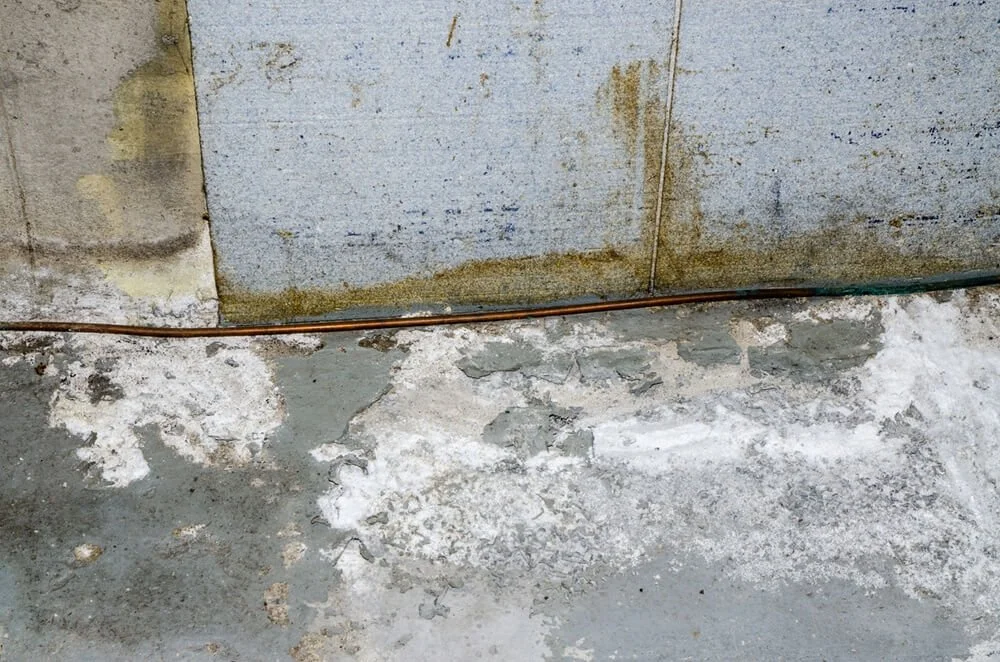
However, before you panic and start throwing away stored belongings, take a deep breath. While that strange white substance clinging to your foundation could indeed be a biological growth, there is a very high probability that it is something entirely different—and entirely harmless.
When dealing with masonry and below-grade walls, homeowners frequently encounter two distinct phenomena that look strikingly similar to the untrained eye: efflorescence and white mould. Understanding the critical differences between these two is the first step toward reclaiming your space. Let’s dive into how you can successfully distinguish between the two, what they mean for your home’s structural health, and how you can banish them for good.
The "White Stuff" Panic: What Are You Looking At?
The confusion between these two substances is incredibly common, and for good reason. Both of them thrive in damp, dark, and poorly ventilated environments. Both of them manifest as white, powdery, or patchy discolorations. Both of them serve as giant, flashing warning signs that your home is suffering from a moisture control problem.
But that is where the similarities end. One is a simple, inert chemical reaction that requires little more than a stiff brush to clean away. The other is a living, breathing fungus that will actively devour organic materials and compromise your indoor air quality. Misidentifying basement mould can lead to unnecessary panic and exorbitant cleaning bills, while ignoring it can lead to severe structural and health consequences. To solve the problem, you must first know exactly what you are fighting.
Contender 1: Efflorescence
If you have a concrete, brick, stone, or stucco surface in a damp environment, you are highly likely to encounter efflorescence. Unlike mould, efflorescence is not a living organism. It is a strictly inorganic mineral deposit. It cannot spread through the air via spores, it cannot cause respiratory illness, and it will not rot the wood framing of your home.
The "Salty" Science: How Water Pushes Minerals Through Concrete
To understand efflorescence causes, we have to look at the microscopic structure of your foundation. Concrete and brick may feel rock-solid, but they are actually highly porous materials, full of tiny capillaries.
When groundwater or soil moisture presses against the exterior of your foundation, it slowly forces its way through these pores. As this water travels through the masonry, it dissolves natural, water-soluble minerals hidden within the cement, such as calcium hydroxide and various hygroscopic salts.
When that mineral-rich water finally reaches the interior surface of your basement wall, the water evaporates into the indoor air. However, the heavy minerals cannot evaporate. They are left behind on the surface, crystallizing into a chalky, white powder. This process is sometimes referred to as calcification on concrete. Because hygroscopic salts actively attract and hold water from the surrounding environment, these mineral deposits can sometimes look slightly damp or frosty, further adding to the visual confusion.
How to Test: The Water Spray Trick
Because efflorescence is essentially just crystallized salt, it behaves exactly like salt when exposed to moisture. This gives homeowners an incredibly easy, foolproof way to test the substance without needing a laboratory.
Take a standard spray bottle filled with clean water and aggressively spritz a small patch of the white powder. Because efflorescence is composed of water-soluble minerals, the powder will immediately dissolve and disappear into the wet concrete. (It will likely reappear once the wall dries again, but the instant vanishing act proves its mineral nature). If you want to be extra thorough, spray the area with a mild acid like household white vinegar; efflorescence will often produce a faint fizzing or bubbling reaction as the acid breaks down the alkaline salts.
Contender 2: White mould (The Fungus)
While efflorescence is a harmless mineral, white mould is a living fungal colony. Mould spores are microscopic and omnipresent in the air around us, but they remain dormant until they find the perfect trifecta of conditions: optimal temperatures, a food source, and, most importantly, liquid water or high humidity. You can read more about mould removal here.
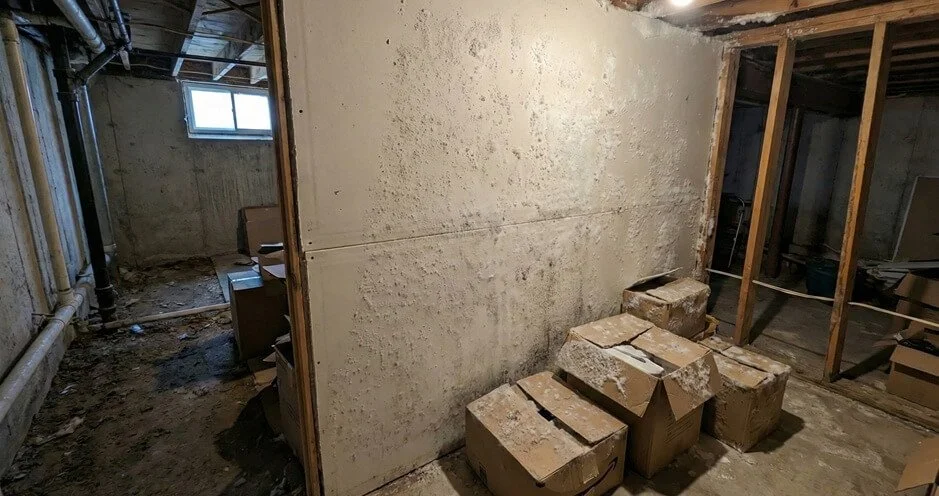
Unlike efflorescence, which only forms on masonry, fuzzy white mould feeds exclusively on organic materials. It actively digests cellulose to survive. Therefore, if you see white powder growing on your wooden floor joists, drywall paper backing, cardboard storage boxes, or old furniture, you can be nearly certain it is mould, as efflorescence cannot form on these materials.
The Smell Test (Musty vs. Odourless)
One of the most reliable ways to distinguish between these two substances doesn't involve your eyes at all; it involves your nose.
Because efflorescence is simply an accumulation of inert calcium and salt, it is completely odourless. If you are standing in a basement covered in efflorescence, the air will just smell like a normal basement.
Mould, on the other hand, releases microbial volatile organic compounds (MVOCs) as it metabolizes and digests its food source. These invisible gases are what produce that classic, pungent, musty, "wet earth" smell associated with damp basements and old cabins. If you are looking at a white patch and your nose is hit with a heavy, damp, rotting odor, you are dealing with a biological growth.
Texture: Fuzzy vs. Chalky
If you put on a pair of rubber gloves and a protective mask, you can also perform a tactile and visual inspection.
Efflorescence is flat, brittle, and powdery. If you rub it between your gloved fingers, it will feel gritty, exactly like table salt or chalk dust. It crushes easily and will quickly brush off the wall.
White mould has a distinct, three-dimensional structure. It often appears fibrous, web-like, or cottony. It does not brush away easily; instead, it tends to smear or mat down when you touch it, clinging stubbornly to the surface of the wood or drywall it is consuming. Furthermore, if you perform the "Water Spray Trick" mentioned earlier, mould will not dissolve. It will simply get wet and stay exactly where it is.
Why Both Signal a "Water Problem" (Even if One is Harmless)
Here is the most critical takeaway for any homeowner: whether your water spray test reveals harmless efflorescence or requires you to call a mould remediation specialist, the root cause is identical. Both of these issues are giant red flags indicating active moisture migration.
Water is penetrating your home's envelope. If you only clean the efflorescence off the wall or bleach the mould off the wood, you are only treating the symptom. The moisture is still moving through your concrete, and the white powder (whether mineral or fungal) will inevitably return.
Furthermore, while efflorescence won't hurt your lungs, the constant movement of water and the crystallization of salts inside the pores of your concrete can eventually cause "spalling"—a condition where the surface of the concrete begins to flake, crumble, and deteriorate, threatening your foundation's structural integrity.
How to Stop Moisture Migration Permanently
To protect your home, you must cut off the water supply at its source. This requires a comprehensive approach to moisture control.
First, look outside. Ensure that your gutters are clear and that your downspouts are discharging water at least six feet away from your foundation. Check the grading of your landscaping; the soil should slope away from your home, preventing rainwater from pooling against the exterior walls.
If exterior drainage correction isn't enough, you will need to look at professional interior solutions. For residents in Southern Ontario dealing with high water tables and heavy spring thaws, investing in professional basement waterproofing St. Catharines experts can provide is often the only permanent fix. This may involve installing an interior weeping tile system and a sump pump to actively manage hydrostatic pressure beneath the slab.
Once the active water intrusion is stopped and the concrete is given ample time to dry, you can apply a high-quality, penetrating masonry sealer to your interior basement walls. A silane-siloxane masonry sealer works by soaking deep into the pores of the concrete and creating a hydrophobic barrier. This allows the concrete to "breathe" vapor out, but prevents liquid water and dissolved salts from passing through to the surface, effectively ending your efflorescence and mould anxieties for good.
Contact Foundation Fix Today
Uncertainty surrounding the foundation of your home can be scary. Contact Foundation Fix today to discuss best practices for identifying issues with your foundation.


