
The “Clay Bowl Effect” In Niagara Homes
/For homeowners in Niagara, the "dream home" often comes with a hidden geological challenge. While we enjoy the lush vineyards and fertile land of the peninsula, the very earth beneath our feet is a primary suspect in basement flooding.
If you’ve ever wondered why your basement feels damp or why you’re seeing a wet basement after rain, the answer likely lies in a phenomenon known as the "Clay Bowl Effect."
Why Niagara's Geology is Hard on Foundations
The Niagara Region is famous for its "heavy clay soil." Specifically, the Haldimand Clay Plain covers much of St. Catharines and surrounding areas. While clay is excellent for holding nutrients for grapes, it is a nightmare for residential engineering.
Clay is composed of fine particles that pack tightly together. Unlike sandy soils, which allow water to percolate through quickly, clay is remarkably non-porous. When it gets wet, it expands; when it dries, it shrinks and cracks. This constant movement creates a hostile environment for concrete foundations, leading to settlement cracks and, eventually, water ingress.You can read more about the expansive nature of clay here.
What is the "Clay Bowl Effect"?
To understand the Clay Bowl Effect, you have to look at how your home was built.
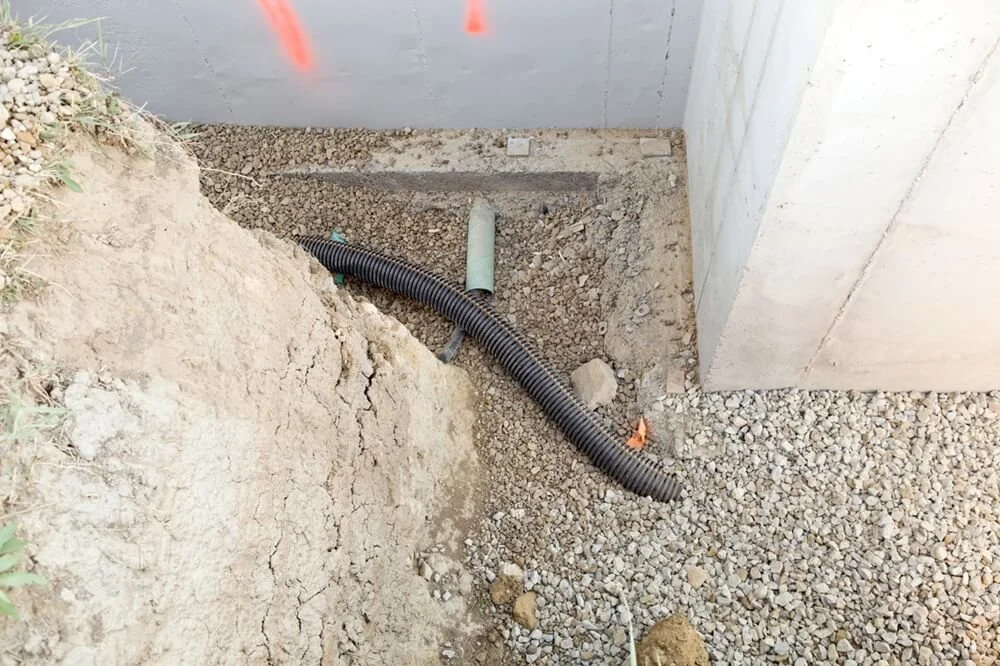
The Construction Process: Virgin Soil vs. Backfill
When a builder prepares to pour a foundation, they excavate a hole significantly larger than the footprint of the house. This creates a "gap" between the exterior foundation wall and the undisturbed, "virgin" soil. Once the concrete walls are poured and cured, the contractor fills that gap back in with loose soil, known as backfill.
The problem is that this backfill soil is never as compacted or dense as the original, undisturbed clay. This creates a pocket of loose, porous earth immediately surrounding your home, encased by the dense, "waterproof" walls of the original clay excavation.
How the "Bowl" Fills Up During Rainstorms
Think of the undisturbed clay around your home as a giant ceramic bowl. Your house is sitting inside that bowl, surrounded by loose backfill dirt. During a typical Niagara thunderstorm, the rain hits the ground and tries to soak in.
Because the surrounding virgin clay is so dense, the water takes the path of least resistance: the loose backfill. The water rushes into the loose soil around your foundation, filling the "bowl" to the brim. Since the clay prevents the water from draining away horizontally into the yard, the water trapped against the foundation has nowhere to go but down.
The Consequence: Hydrostatic Pressure & Leaks
As the "bowl" fills, gravity pulls the water toward the bottom of your foundation. This leads to a build-up of hydrostatic pressure. Hydrostatic pressure is the pressure exerted by a fluid at equilibrium at a given point within the fluid, due to the force of gravity.
In layman's terms: the water sitting in the backfill is heavy. A cubic foot of water weighs about 62.4 pounds. When thousands of gallons of water are trapped against your basement walls, the pressure becomes immense. This pressure forces water through even the tiniest hairline cracks in your concrete, through the joint where the wall meets the floor (the cove joint), or even through the porous concrete itself. This is why many Niagara homeowners experience a wet basement after rain even if their foundation appears solid.
The Solution: Breaking the Bowl
You cannot change the geology of the Niagara region, but you can change how your home interacts with it. To prevent the Clay Bowl Effect from destroying your basement, you must manage both the water's entry and its exit.
Importance of Exterior Waterproofing Membranes
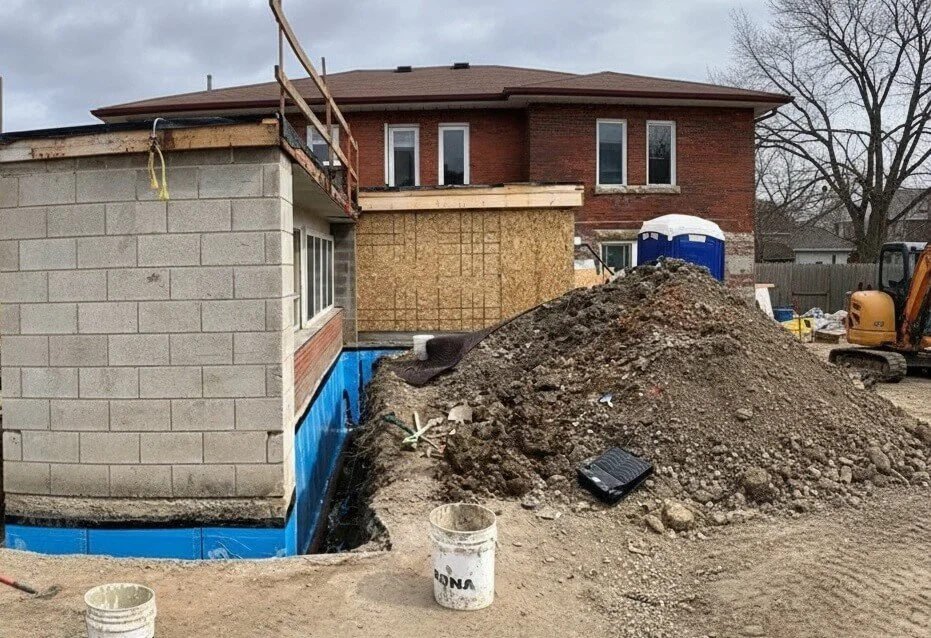
The first line of defense is a high-quality foundation waterproofing membrane. Modern membranes are not just "damp-proofing" (which is essentially just a thin layer of spray-on tar). A true waterproofing system involves a thick, rubberized coating and a dimpled drainage board.
The dimpled board serves two purposes:
It acts as a physical barrier.
It creates an air gap that allows water to fall straight down to the weeping tile, preventing hydrostatic pressure from building up against the wall.
Proper Grading & Swales
The second step is grading for clay soil. Because Niagara's clay is so stubborn, you cannot rely on the soil to absorb water. You must use physics to move it away.
The ground should slope away from your home at a rate of at least one inch per foot for the first six feet. In many Niagara subdivisions where houses are close together, "swales" (shallow, grass-lined channels) are used to collect this runoff and direct it toward the municipal storm drains or the street. If your grading has settled over the years, a common occurrence in heavy clay, you are essentially inviting the "bowl" to fill faster.
Why "Just Filling the Dirt" Doesn't Work
Many homeowners try to fix a sinking area near their foundation by simply dumping more soil or mulch into the depression. This is a temporary cosmetic fix that often worsens the problem.
Adding more loose soil doesn't stop the backfill drainage issues; it just provides more material for the water to saturate. If that soil isn't properly sloped and compacted, or if it’s a high-organic "garden soil," it acts like a sponge, holding moisture against the foundation longer.
To truly fix the Clay Bowl Effect, the solution usually requires a combination of:
Mechanical Drainage: Ensuring your weeping tiles are clear and connected to a functional sump pump.
Surface Diversion: Extending downspouts at least six feet away from the foundation.
Subsurface Barriers: Using bentonite or professional-grade membranes to ensure water never touches the concrete.
Contact Foundation Fix Today
Living in the Niagara Region means accepting that our soil is constantly working against our basements. However, by understanding the mechanics of the Clay Bowl Effect, you can move from reactive repairs to proactive protection. If you notice cracks in your cold cellar or water seeping in after a spring thaw, remember: it’s not just "bad luck," it’s physics. Contact Foundation Fix today to discuss proactive measures you can take to preserve your foundation.


