
Foundation Underpinning vs. Helical Piers: Restoring Sinking Foundations in Southern Ontario
/For residential and commercial property owners near Niagara and St. Catharines, structural stability is an ongoing battle against the region’s unique subsurface geology. From the heavy glaciated lacustrine clay deposits of the Niagara Peninsula to the dense, variable tills of the Greater Toronto Area (GTA), the ground beneath our feet is continuously shifting. When a foundation begins to fail, the consequences are both visually alarming and structurally catastrophic.
Cracked drywall, jammed doors, unlevel flooring, and stepped masonry fracturing are classic indicators that a building’s structural footprint is no longer resting safely on competent soil.
Restoring structural integrity to a failing foundation requires looking beyond superficial structural cosmetics and addressing deep subgrade mechanical failures. In modern structural engineering, two primary intervention methods exist to halt foundational descent and safely transfer structural loads deeper into the earth:
Traditional mass pour concrete foundation underpinning
Engineered helical piering systems
Both technologies aim to establish a permanent solution to foundation settlement. Yet, their methodologies, geological parameters, installation footprints, and cost dynamics vary significantly. Choosing the correct intervention requires an analytical understanding of regional geotechnical conditions, building loads, and structural mechanics.
Decoding Differential Settlement: Why Niagara Foundations Sink Unevenly
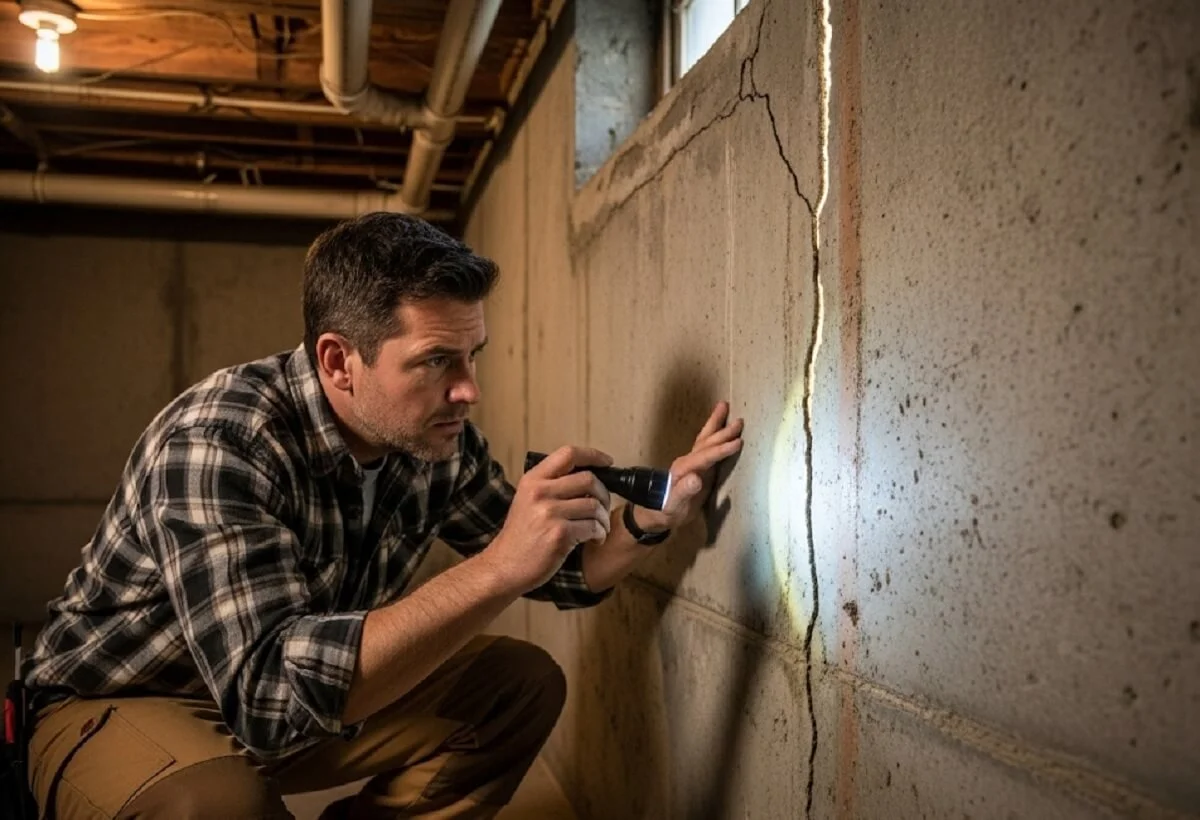
To understand the mechanics of structural remediation, one must first explore the foundational enemy known as differential settlement. Unlike uniform settlement, where an entire building sinks evenly into the ground with minimal structural distortion, this phenomenon occurs when one portion of a structural concrete footprint settles at an accelerated rate compared to adjacent sections. This uneven rate of movement introduces immense internal stress, shear forces, and rotational moments into structural grade beams, concrete block foundation walls, and framing systems, rapidly leading to severe structural failure. We also see the impacts of the clay bowl effect, which you can read more about here.
In regions such as the Niagara Peninsula, Hamilton, and Haldimand County, this issue is profoundly exacerbated by the presence of highly reactive, over-consolidated shifting clay soils. These fine-grained glaciated clay matrixes possess high shrink-swell potentials that respond drastically to changes in moisture content.
Wet Southern Ontario Springs and Autumns: The clay absorbs moisture, swelling and exerting upward hydrostatic and lateral pressures on foundation walls.
Hot, Dry Summer Spells: These clay layers undergo severe desiccation, shrinking and leaving massive subsurface voids directly beneath structural footings.
This perpetual cycle of volumetric expansion and contraction systematically undermines shallow foundation systems. Furthermore, several human and environmental variables create localized moisture imbalances:
Mature tree root systems drawing moisture away from the perimeter
Poorly configured downspouts
Improper grading
The final result is a highly localized loss of subgrade support. This causes portions of the home to drop into the voids while other sections remain stable, fracturing the home’s primary structural skeleton.
The Traditional Approach: Mass Pour Concrete Foundation Underpinning
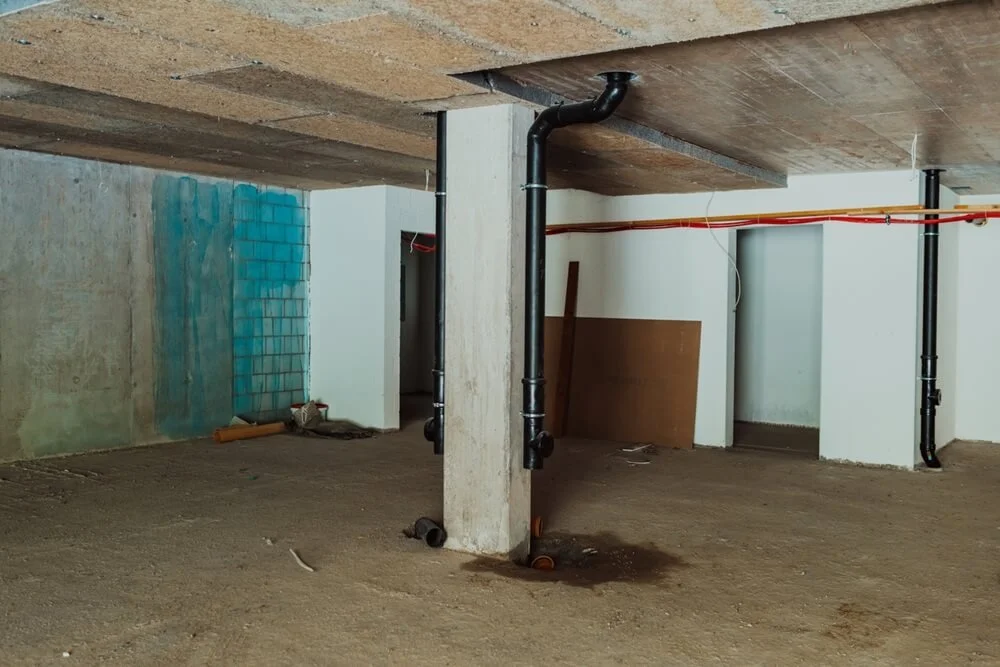
When engineering intervention is deemed necessary to arrest this uneven structural movement, traditional mass pour concrete underpinning is often the first method scrutinized. This structural methodology relies on extending the existing foundation depth vertically downward until it reaches a stable, deeper soil layer capable of safely supporting the load.
The primary engineering goals of this method include:
Increasing the footprint and structural depth of the building's base by anchoring onto shallow stable soils.
Distributing the building weight across a larger surface area using traditional hand excavation tools, concrete mixers, and pump trucks.
Anchoring the structure onto more stable material below the active frost and moisture zones, typically four to eight feet below grade.
Traditional underpinning remains a reliable structural choice for projects with shallow stable strata. It is also highly effective where basement heights must be simultaneously augmented through deep interior underpinning. However, it is an incredibly invasive, labour-intensive discipline that fundamentally alters the immediate soil-structure interface around a building’s perimeter, making actual structural lifting exceptionally difficult and risky to execute safely.
Deep Hand Excavation and Sequential Concrete Footing Extension
Executing traditional foundation underpinning requires a highly calculated, sequential construction methodology. This strict staging is vital to prevent inducing catastrophic structural collapse during excavation. Because the earth supporting the home is being systematically removed, technicians cannot excavate the entire perimeter at once.
Instead, the workflow follows a precise pattern:
The foundation perimeter is divided into distinct, numbered segments called "pins", which are typically three to four feet in width.
These pins are arranged and excavated in a non-consecutive, alternating sequence, such as digging pins 1, 5, and 9 in the first phase.
Labourers initiate deep hand excavation beneath the designated pins.
They carefully remove the shifting clay soils and dig beneath the existing footing to the engineered depth specified by a structural engineer.
Once a pin cavity is dug out down to a dense, non-active stratum, heavy wood or steel forming is installed within the cavity.
Steel reinforcing bars (rebar) are placed into the void, extending horizontally past the form borders to ensure structural continuity with adjacent pins when poured in later sequences.
High-strength concrete is then pumped or poured directly into the deep void, forming new structural concrete footings beneath the original, failing foundation wall. Because concrete undergoes slight shrinkage during its curing phase, a physical gap of approximately two to three inches is left between the top of the newly poured concrete pin and the underside of the original footing. Once the structural concrete achieves its required compressive strength, this remaining gap is tightly packed with non-shrink dry-pack grout. This establishes complete structural continuity and completes the vertical extension of the foundation.
Geotechnical Engineering Note on Southern Ontario Tills
In locations across Mississauga, Oakville, and Toronto, underpinning must often penetrate past highly weathered surface clays to reach dense Halton or Newmarket Till. If these stable strata are buried too deeply, traditional hand excavation becomes prohibitively dangerous and cost-ineffective, forcing a shift to deep piering alternatives.
The Modern Engineering Approach: Helical Piering Solutions
As structural engineering evolved, the physical limitations and intense labour demands of deep hand-excavated concrete underpinnings led to the development of deep mechanical foundation systems. Foremost among these modern engineering methods is the installation of helical piering solutions. Rather than attempting to expand the existing concrete footprint via mass concrete pours, helical piering functions by completely bypassing unstable, low-bearing surface soils altogether and transferring the building's entire weight down to deep, reliable strata.
A helical pier consists of:
A central high-strength structural steel shaft
One or more helix-shaped steel plates welded to its lower sections
These piers function essentially as deep-foundation anchors that are mechanically driven deep into the earth. The installation process is highly controllable, utilizing real-time hydraulic data to guarantee that each pier satisfies specific load capacities before being structurally integrated into the building.
Screwing Steel Piles into Dense Structural Load-Bearing Strata
The mechanical installation of helical piers follows a highly structured, lower-impact methodology:
Technicians use low-impact, high-torque hydraulic drive heads mounted to compact construction equipment, such as mini-excavators or skid steers.
This compact configuration allows technicians to work efficiently within tight residential setbacks, minimizing overall property disruption and keeping the installation footprint confined to minimal, localized access pits at each pier point.
The hydraulic drive head applies continuous downward force and rotational torque, screwing the steel pile cleanly into the ground, much like a self-tapping screw penetrating hardwood.
As the initial lead section of the pier descends, additional steel shaft extensions are securely bolted or welded onto the preceding section, allowing the pier assembly to reach profound depths.
The installation continues until the helix plates advance through the problematic shifting clay soils and securely bite into dense, unyielding load-bearing strata.
Depending on the precise geological characteristics of the Southern Ontario landscape, this stable zone may consist of dense glacial till, cemented sand and gravel formations, or solid rock. In many cases along the Niagara Escarpment, the piers are driven continuously until they achieve direct refusal upon reaching competent bedrock depth.
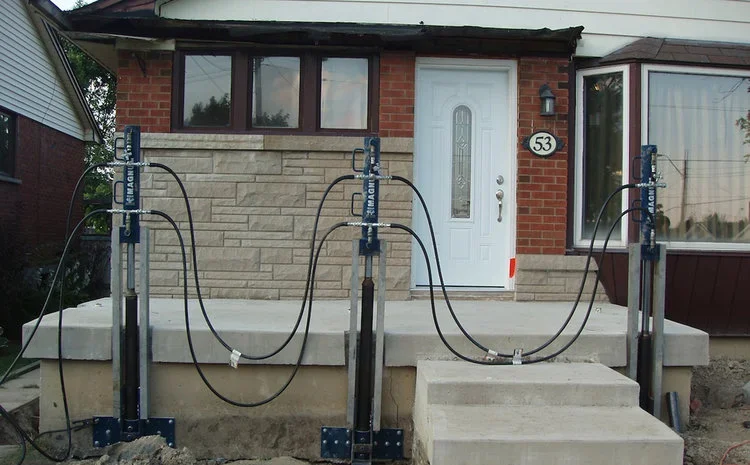
Once the pier achieves its targeted mechanical torque rating, which correlates mathematically to its ultimate load-bearing capacity, the installation is complete. The top of the steel shaft is cut to the exact engineered elevation, and a heavy-duty industrial steel load transfer bracket is mounted to the pier head. This structural bracket is positioned directly underneath the existing concrete foundation footing, creating a rigid mechanical connection capable of receiving and supporting the structural load.
Engineering Face-Off: Geotechnical Soil Density and Structural Weight Limits
When selecting between mass pour concrete underpinning and helical piering for a Southern Ontario property, a structural engineer must execute a comprehensive evaluation matching the structural engineering realities to the site-specific geotechnical profile. The choice is never arbitrary; it depends heavily on structural loads, soil density profiles, and the depth of competent strata.
Geotechnical soil profile variation across Southern Ontario dictates which technology can physically achieve success. Traditional concrete underpinning is limited by human excavation bounds and the safety realities of open-trench digging. If a property in the GTA sits on a deep layer of soft, unconsolidated organic silt or highly active clay that stretches twelve feet down before encountering dense till, hand-underpinning becomes unsafe and economically unfeasible. Pouring mass concrete into deep trenches under these conditions would require a massive volume of concrete, drastically increasing the building’s dead weight and accelerating the failure of the underlying weak soils.
Helical piers excel in this exact geotechnical scenario. Because the slender steel shafts add negligible mass to the foundation while utilizing deep end-bearing mechanics, they effortlessly pierce through twenty, forty, or even sixty feet of poor soil to reach the required bedrock depth. Rather than expanding the footing locally, they use deep end-bearing and skin friction to bypass weak layers.
However, helical piers can encounter limitations in soils filled with large glacial erratics, dense boulder fields, or heavy shale fragments common to parts of the Niagara Escarpment
Operational Realities: Speed, Vibration Risks, and Long-Term Structural Warranties
Beyond structural load equations and soil mechanics, property owners and project managers must carefully evaluate the operational impacts of each foundation restoration method. The chosen system directly influences project timelines, landscape disruption, neighbourhood relations, and future structural liability.
Project Speed
Project speed is an area where helical piering holds a distinct operational advantage. A standard residential foundation stabilization project utilizing helical piers can typically be completed in three to five business days. Because the process avoids bulk earth excavation and eliminates concrete curing lag times, the hydraulic lifting systems can be hooked up and engaged immediately following pier placement.
Traditional mass pour underpinning, by contrast, is a multi-week operational undertaking. The meticulous process of digging out alternating pins, building structural forms, pouring concrete, waiting for the material to cure to target compressive strength, and dry-packing the gaps must be repeated across multiple cycles, extending project schedules and prolonging site disruption.
Vibration Risks
Vibration risk is another critical parameter, particularly in historic urban cores like downtown Hamilton, Toronto's Cabbagetown, or older areas of St. Catharines. In these neighbourhoods, aging brick-and-mortar homes sit very close to property lines, sharing delicate party walls or structural boundaries.
Impact of High-Impact Equipment: Utilizing heavy impact equipment or high-impact driven piles to stabilize a foundation can send seismic shockwaves through the ground, inadvertently fracturing fragile historic masonry on neighbouring properties.
Impact of Traditional Underpinning: This method minimizes vibration risk by utilizing manual hand tools for excavation, but it carries a higher risk of localized soil relaxation, where neighbouring soil can slough into the open trench.
Impact of Helical Piers: Helical pier installation represents the safest alternative, as the smooth, rotational screwing action generates virtually zero vibrational signature, protecting delicate historic structures.
Long-Term Structural Warranties
Finally, long-term structural warranties and structural peace of mind must be factored into the project equation. Because traditional concrete underpinning relies heavily on the quality of on-site manual labour, manual concrete mixing, and the variable conditions of an open excavation trench, warranties are usually tied directly to the structural contractor's operating bond.
Conversely, helical piering systems utilize factory-certified, engineered steel components that are heavily galvanized to resist underground corrosion for generations. Furthermore, because each pier's load-bearing capacity is validated by digital hydraulic torque readouts during installation, structural engineers can definitively sign off on performance metrics. This allows manufacturers and specialized contractors to issue comprehensive, long-term transferable structural warranties, often extending from 25 years to a lifetime, adding measurable resale value and peace of mind to the Southern Ontario property investment.
Contact Foundation Fix Today
Ultimately, restoring a sinking foundation requires a careful balance of geotechnical realities, engineering metrics, and operational goals. For shallow foundational failures in boulder-heavy soils, traditional mass concrete underpinning remains a time-tested option. However, for deep structural settlement within Southern Ontario's active clay matrices, modern helical piering offers speed, precision, and reliable lifting performance, stabilizing properties and ensuring they remain level for decades to come.
If you notice your foundation is sinking, contact Foundation Fix today to discuss the best solutions for your property.


